
From what we have seen across the Florida market, auto insurance rates are a major source of stress for homeowners and business owners alike. Managing multiple vehicle policies makes sudden premium hikes a serious budget issue.
The primary concern is always figuring out what triggers those cost increases.
Does a windshield claim raise insurance in Florida?
The data shows a clear distinction between a simple glass repair and an actual driving penalty. This guide breaks down the exact laws protecting you, explains how underwriting databases work, and provides a clear script for talking to your agent.
Why people hesitate before filing: Does a windshield claim raise insurance in Florida?
We hear the exact same sentence from drivers several times a week. People know the service is supposed to be covered, yet they worry about their premiums going up. This hesitation is a completely fair instinct.
Most drivers have been told their whole adult life that filing any claim is expensive in the long run. That instinct comes from bad experiences with collision claims.
Glass repair simply does not fall into that category. Before you book a mobile windshield replacement, it pays to understand why insurers put these two things in different buckets.
Common sources of hesitation
- Fear of rate hikes: Drivers assume any interaction with their carrier results in a financial penalty.
- Confusion about coverage: Many people mix up collision rules with comprehensive guidelines.
- Deductible concerns: Customers often forget about specific state waivers designed to save them money.
Non-fault versus at-fault, in plain terms
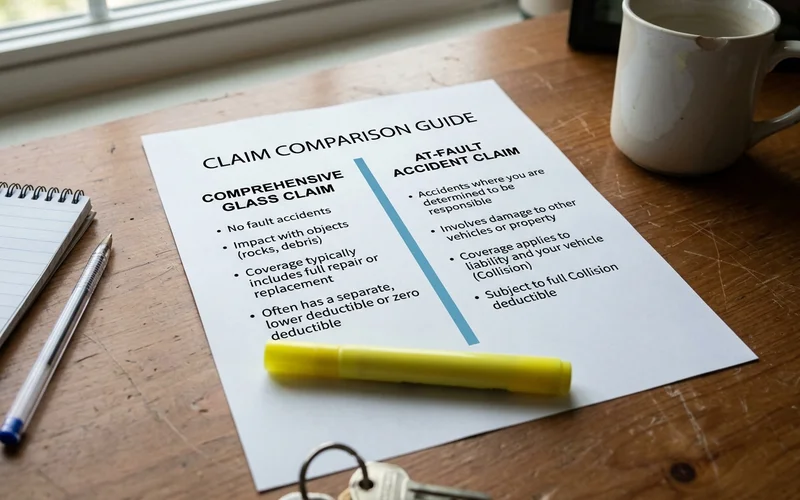
Auto policies split losses into distinct categories, and the category matters far more than the dollar amount. A windshield repair is a non-fault comprehensive loss, which means it is treated differently than an at-fault collision.
At-fault collision claims are the ones that actually move your premiums. You hit a pole, the carrier pays the body shop, and the underwriting model now reads you as a higher risk. That is a behavioral signal, and the company prices it accordingly.
| Claim Type | Who or What Caused It? | Impact on Premium |
|---|---|---|
| At-Fault Collision | Driver error or behavior | Typically results in a rate surcharge |
| Comprehensive Glass | Environmental factors (rocks, hail) | Usually protected under non-fault rules |
Comprehensive claims cover incidents that happen to your car due to outside forces. This includes hail damage, a stolen vehicle, a deer strike, or a rock kicked up by a truck on I-75. There is no driver behavior to re-price, because a rock is just a rock.
Our team explains this daily, but the law makes it even clearer. Under Florida Statute 627.7288, insurance companies must waive the deductible for windshield replacements if you carry comprehensive coverage. The state enacted this specific mandate to remove the cost barrier that previously kept drivers on the road with unsafe glass.
What honestly can happen
We cannot guarantee an outcome that your specific carrier controls. Here is the most accurate version of what you can expect.
Three common post-claim scenarios
A single glass claim on a clean record represents the overwhelming majority of the jobs we perform. This type of claim shows on your loss history as a non-fault comprehensive incident and rarely moves the premium.
Several glass claims in a short window can complicate things. Some carriers review the frequency across all claim types to evaluate risk. Three broken windshields in eighteen months might attract attention at renewal time. Underwriting models flag patterns, so ask your agent point-blank before filing if you fall into this category.
Statewide rate changes happen frequently for reasons entirely unrelated to your driving. As of early 2026, data from the Florida Office of Insurance Regulation shows the top five auto groups actually filed for average rate decreases of around 8% due to tort reforms. If your renewal goes up the same quarter you replaced a windshield, the two events are often unconnected. You should always ask what the base rate did across your local zip code.
The question worth asking your agent
Not “will this raise my rates?”, they’ll hedge. Ask: “Is a comprehensive glass claim rated as a chargeable loss on my policy?” That’s a yes-or-no question their system can answer.
What actually appears on your record
Claims are reported to industry loss-history databases, most commonly LexisNexis. When you shop for a new policy, a carrier pulls a Comprehensive Loss Underwriting Exchange (CLUE) report to view your history for the last five to seven years.
A glass claim shows up there, and it is explicitly labeled as a comprehensive loss. The underwriter reading the file sees the exact same thing your current carrier sees. The damage happened to the car rather than because of how you drive.
Our experience shows that switching carriers after a glass claim does not hide the event. Agents see these specific entries constantly, and they weigh them correctly as non-fault incidents.
Under the Fair Credit Reporting Act, you are entitled to request a free copy of your CLUE report every 12 months. Reviewing your own file is a smart move for any property owner to ensure accurate reporting.
What underwriters look for on a CLUE report
- Type of loss: Confirming whether the incident was a collision or a comprehensive event.
- Date of the incident: Checking exactly how recently the damage occurred.
- Amount paid: Seeing the exact total the carrier covered for the replacement.
- Claim status: Verifying if the file is currently open, closed, or denied.
Getting a straight answer before you commit
If you want total certainty before filing, a two-minute call to your agent provides it. You simply need to ask the right questions to get past the generic customer service scripts.
Here are the three specific questions worth asking, in this exact order:
- Is comprehensive glass rated as a chargeable loss on my policy?
- Does my carrier apply any frequency rule to non-fault comprehensive claims?
- Has my base rate changed in this zip code at the last two renewals?
That third question matters far more than people expect. A clear answer separates a rate change caused by your specific claim from a market-wide rate adjustment that was coming anyway.
Will a glass claim increase rates in Florida for your specific profile? Only your carrier has the final mathematical formula, but getting these direct answers gives you total clarity.
The cost of not filing
Driving on damaged glass carries a significant safety price that goes beyond cosmetic issues. A crack in the driver’s sightline remains a failed inspection issue in plenty of states and a severe citation risk right here in Florida.
Structurally, the windshield performs a massive job during an accident. The Auto Glass Safety Council reports that a windshield provides up to 45% of the cabin’s structural integrity in a front-end collision. That number jumps to 60% during a rollover incident. Compromised glass fundamentally changes how the vehicle protects your family in a wreck.
Risks of ignoring cracked auto glass
- Airbag failure: The windshield acts as a critical backstop for passenger-side airbag deployment.
- Roof collapse: Weakened glass cannot support the roof frame properly during a severe rollover.
- Legal citations: Police officers regularly issue expensive tickets for obstructed views.
- Escalating costs: Tiny chips turn into massive cracks quickly under the hot summer sun.
There is also a strict repair-versus-replace clock ticking on every small chip. A small blemish can often be filled with resin in twenty minutes. Let that damage spread, and you are buying a full replacement instead.
Our intense Florida heat shortens that repair window dramatically. You can read our detailed guide on free windshield replacement in Florida to see exactly how the coverage side works before the crack spreads.
How we handle the claim for you
You do not have to call the claims department yourself. Send us your insurance details and vehicle information, and our dedicated team handles the entire administrative process on your behalf.
We file the initial claim, confirm the deductible waiver, and bill the carrier directly. As a preferred shop for major carriers like State Farm, Progressive, and GEICO, our system integrates directly with theirs. Our technicians work with every major carrier writing policies in Florida.
If your specific policy turns out to be an odd one, our staff will tell you immediately. We always verify coverage details before we schedule anything, rather than waiting until the old glass is already out of the frame. Does a windshield claim raise insurance in Florida for your specific vehicle? Send us a message today with your policy number, and we will get you the exact answer and safely back on the road.