What is ADAS calibration?
ADAS stands for Advanced Driver Assistance Systems, the group of features that watch the road for you. Automatic emergency braking, lane-keep assist, adaptive cruise control, traffic sign recognition. On most vehicles, all of them read the world through a single camera mounted to the inside of the windshield.
That camera is aimed with very little margin. A fraction of a degree at the lens becomes several feet of error a hundred yards down the road. Calibration is the procedure that re-teaches the camera exactly where straight ahead is, relative to the vehicle’s actual centreline. If you want the longer explanation first, our guide on what ADAS calibration is covers the fundamentals.
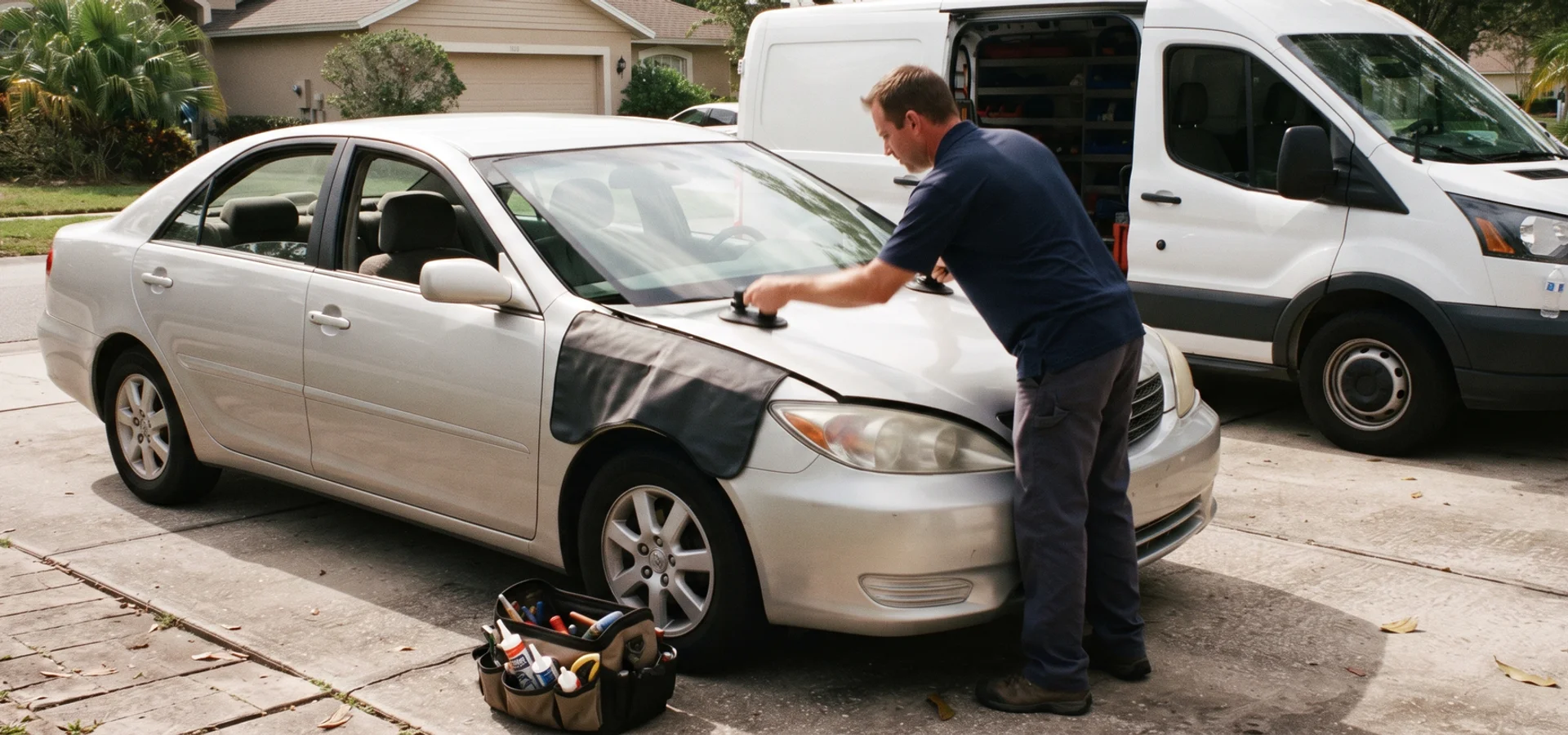
Any time the glass comes out, the camera’s reference moves with it. That’s why calibration isn’t an optional add-on to a mobile windshield replacement, it’s the second half of the same job.
How does the calibration process work?
There are two procedures, and the manufacturer decides which one your vehicle needs.
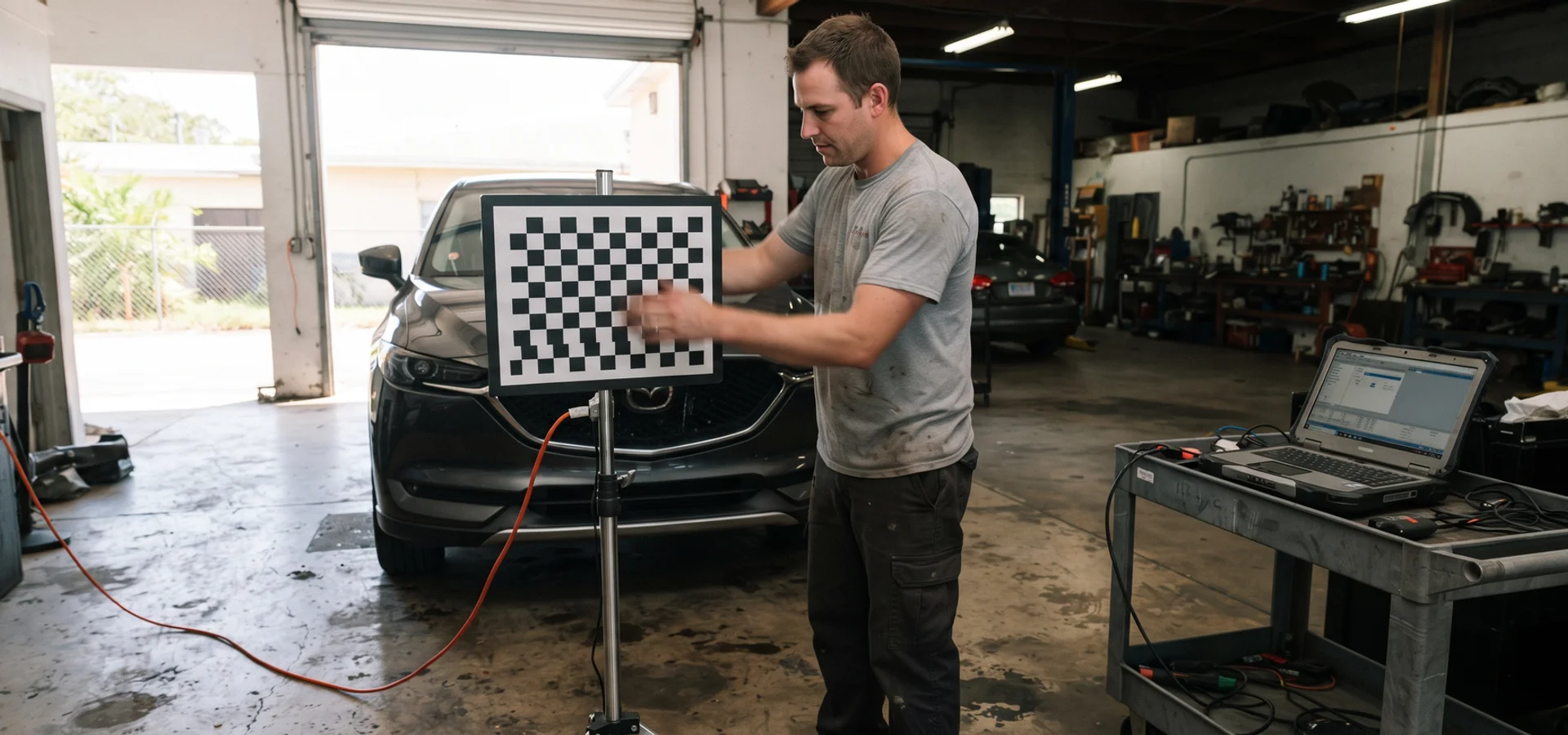
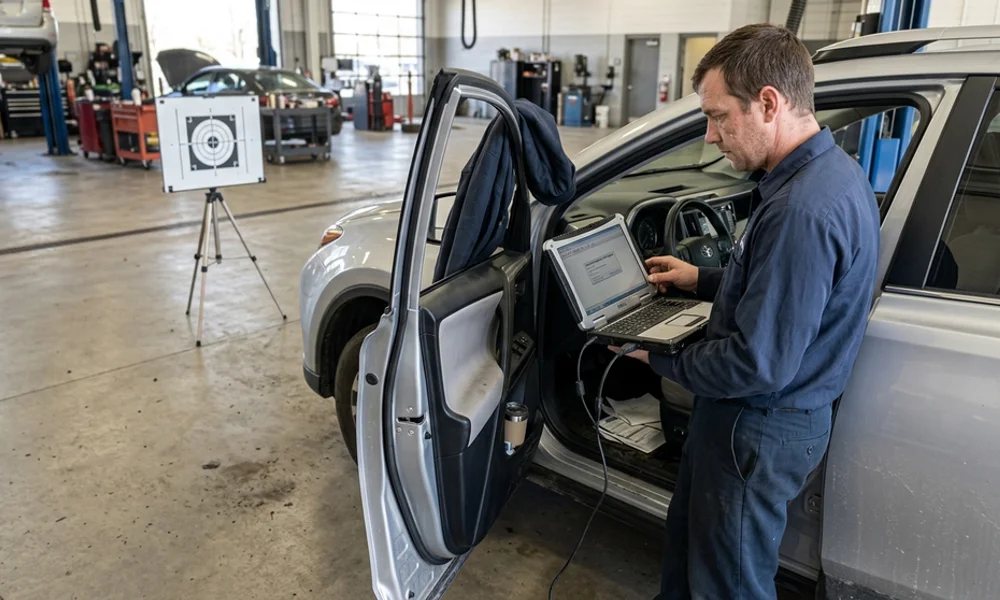
Static calibration happens with the car stationary. We park on a level surface, set tyre pressures, and position a printed target board at a measured distance and height directly in front of the camera. The scan tool then runs the routine while the camera studies a pattern it knows the exact dimensions of.
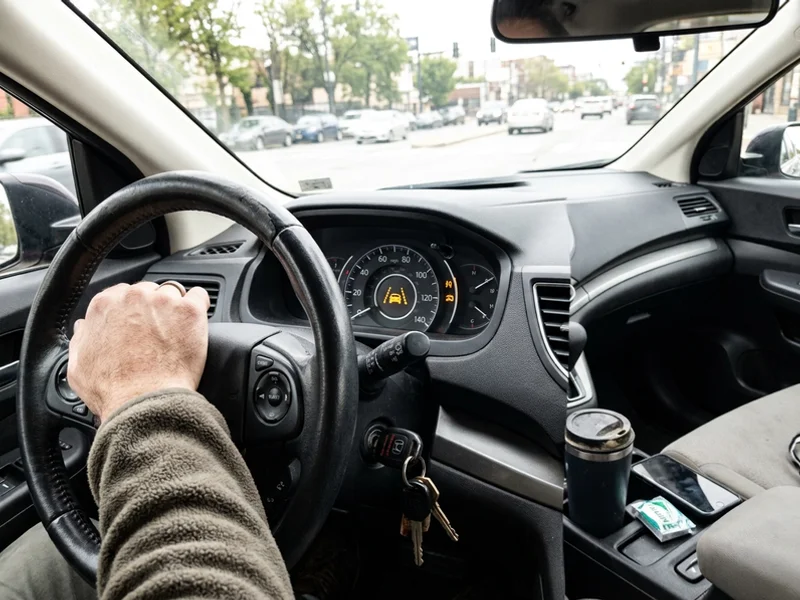
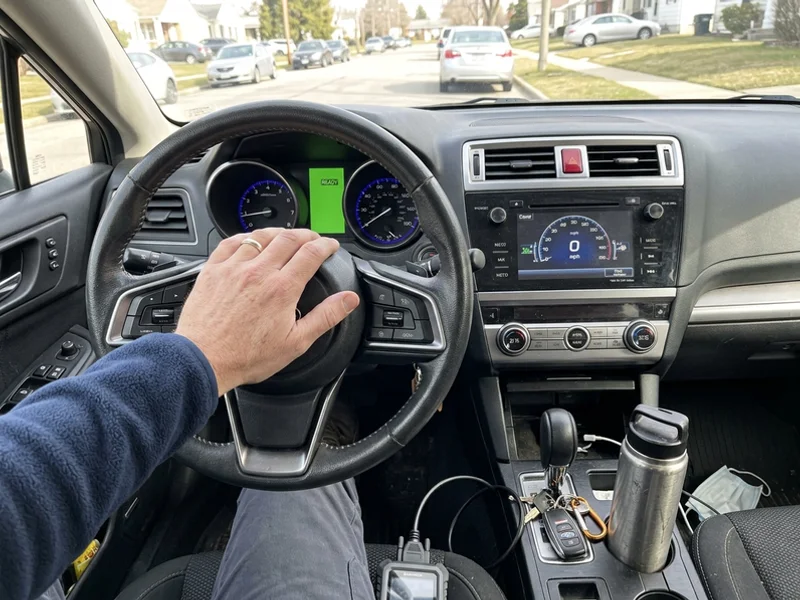
Dynamic calibration happens on the road. The scan tool puts the camera into learn mode and we drive a set cycle, usually a stretch of clearly marked road at a steady speed in decent light, until the system reports it has enough data.
Some vehicles need one. Some need the other. A growing number need both, in a specific order. We look up your exact year, make, model, and trim rather than assuming.
Both procedures travel. Our vans carry the target boards and scan tools, so calibration happens at your address in the same visit as the glass work, anywhere our mobile auto glass service runs between Ocala and Naples.
Which vehicles need ADAS calibration?
| System name | Common brands | Typical model years |
|---|---|---|
| Toyota Safety Sense | Toyota, Lexus | 2016 onward, near-universal from 2018 |
| Honda Sensing | Honda, Acura | 2016 onward, near-universal from 2019 |
| Ford Co-Pilot360 | Ford, Lincoln | 2019 onward |
| EyeSight | Subaru | 2015 onward (dual-camera, always static) |
The quickest check is to look at the top centre of your windshield from inside the cabin. If there’s a black housing behind the mirror with one or two lenses pointing forward, your vehicle almost certainly needs calibration after glass work. If you’re not sure, give us the VIN and we’ll confirm it in a minute. Our guide on which vehicles need ADAS calibration walks through it in more detail.
What you get when we’re finished
We don’t just tell you it passed. You get the pre-scan showing what the vehicle reported before we started, the post-scan showing a clean bill afterward, and a note of which procedure was performed. Keep it with your service records, if you ever sell the car or make a claim, that documentation answers questions before anyone has to ask them.
What's included
- Static (target board) and dynamic (road-cycle) calibration
- Pre-scan and post-scan diagnostic verification
- Calibrated to OEM tolerance, documented in writing
- Done in the same visit as your windshield replacement
- Covers Toyota Safety Sense, Honda Sensing, Ford Co-Pilot360 and more